EUIPO Upholds Opposition in Dormella v Dormeo on Likelihood of Confusion Grounds
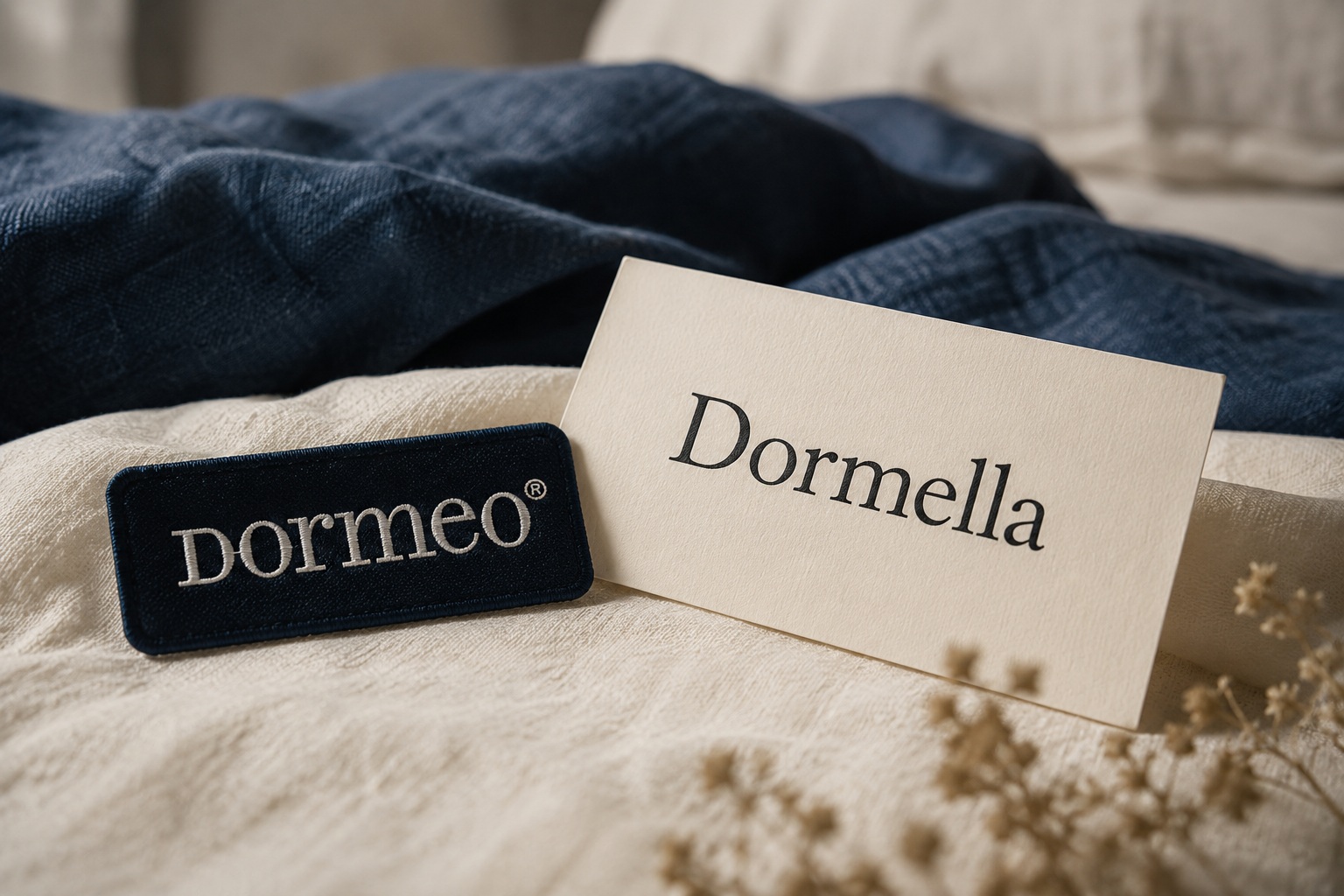
The decision of the Opposition Division of the European Union Intellectual Property Office in Opposition No B 3 247 034 concerns an opposition brought against EU Trade Mark Application No 19 196 295 for the word mark Dormella. The opposition was filed by the proprietor of the earlier figurative mark Dormeo, protected through an international registration designating the European Union, and was upheld in its entirety for all contested Class 24 goods.
The dispute arose in relation to bedding and household textile products, a category in which branding plays a central role due to the functional homogeneity of the underlying goods. Products such as bed linen, duvet covers, blankets and pillowcases are typically indistinguishable on technical grounds, meaning that trade marks operate as the primary source identifier in the purchasing decision.
The Opposition Division applied Article 8(1)(b) EUTMR and concluded that the similarities between the signs, when assessed in conjunction with the identity of the goods, gave rise to a likelihood of confusion for the relevant public.
Identity of Goods and the Interpretation of Class 24 Specifications
A central aspect of the decision concerned the comparison of goods under Class 24. The earlier registration covered a broad range of textile goods, including bed covers, bed linen, pillowcases and related items. The contested application covered materially identical goods within the same class.
The Opposition Division treated the goods as identical. In doing so, it relied on the established interpretative approach according to which the term “including” in trade mark specifications is understood as illustrative rather than exhaustive. This approach is well embedded in EUIPO practice and ensures that protection is not artificially narrowed by the drafting structure of the specification.
The consequence of this interpretation is that earlier registrations in Class 24 often confer a broad protective scope. In practical terms, this means that applicants seeking protection for sub-categories of bedding or textile goods will frequently be assessed as targeting identical goods where the earlier mark covers the broader category.
Comparison of the Signs and the Role of the Dominant Element
The comparison was carried out between the earlier figurative mark Dormeo and the contested word mark Dormella. The Opposition Division identified the verbal element of the earlier mark as the dominant component, with the figurative presentation playing a secondary and largely decorative role.
The marks were found to be visually and phonetically similar to a below-average degree. However, this level of similarity was considered sufficient in the overall assessment when combined with the identity of the goods.
The key structural feature driving the assessment was the shared initial sequence “DORME–”. The Opposition Division placed particular emphasis on this element, reflecting the consistent approach in EU trade mark practice that consumers tend to focus on the beginning of a sign when perceiving and recalling trade marks.
Although the endings of the marks differ (“-o” in Dormeo and “-lla” in Dormella), these differences were not considered sufficient to overcome the similarity created by the common prefix. The analysis was based on the overall impression of the signs rather than a side-by-side comparison of their components.

Conceptual Neutrality and the Absence of Semantic Differentiation
An important factor in the assessment was the absence of conceptual meaning in both marks. The Opposition Division found that neither Dormeo nor Dormella conveys any identifiable concept for a significant portion of the relevant public, including consumers in certain linguistic regions of the European Union.
This finding removed any possibility of conceptual differentiation between the signs. Where trade marks are devoid of semantic content, the assessment necessarily focuses on visual and phonetic similarities, which tend to assume greater importance in the global evaluation.
The absence of conceptual meaning also has a structural effect on the analysis: it eliminates one of the potential balancing factors that might otherwise reduce the impact of phonetic or visual similarities. In cases involving coined or invented terms, this often results in a more rigid reliance on structural comparison.
The Role of the Average Consumer and Imperfect Recollection
The assessment of likelihood of confusion was conducted from the perspective of the average consumer, who is deemed to be reasonably observant and circumspect but not to engage in detailed analysis of trade marks.
A key element of this standard is the principle of imperfect recollection. Consumers do not compare marks directly but rely on an imprecise memory of their overall impression. As a result, the most distinctive and immediately perceptible elements of a mark tend to dominate recollection.
In the present case, the shared “DORME–” element is likely to function as the primary cognitive reference point. The suffix variations are less likely to be retained with precision, particularly in relation to low-involvement consumer goods such as bedding and household textiles.
This perceptual mechanism increases the likelihood that consumers will perceive the marks as related or commercially connected, even where differences are identifiable upon closer inspection.
Associative Confusion and Perceived Economic Link
The concept of confusion under Article 8(1)(b) EUTMR extends beyond direct misidentification. It also encompasses situations in which the relevant public assumes that the goods originate from economically linked undertakings.
This form of associative confusion is particularly relevant in modern trade mark practice, where brand architectures frequently include sub-brands, product lines and licensing structures sharing common linguistic elements.
In the present case, the structural similarity between Dormella and Dormeo is capable of creating an impression of brand extension or commercial affiliation. The shared prefix reinforces this perception, particularly in the absence of conceptual differentiation.

Interdependence and the Canon Principle
The outcome of the case is grounded in the principle of interdependence established in Canon. Under this principle, a lesser degree of similarity between marks may be offset by a higher degree of similarity between goods.
Given that the goods in question are identical, the threshold for similarity between the marks is correspondingly reduced. Even below-average similarity is sufficient where other factors point towards a risk of confusion.
This balancing exercise remains central to Article 8(1)(b) EUTMR and reflects the functional nature of trade mark protection in EU law, which is designed to prevent market distortion arising from consumer misperception of commercial origin.
Figurative Elements and Their Limited Legal Impact
The figurative aspects of the earlier mark were considered to have limited significance in the overall assessment. The stylisation and background elements do not alter the pronunciation or structural perception of the mark and therefore do not materially affect the global impression.
This approach is consistent with established EUIPO practice, according to which verbal elements generally carry greater weight than figurative components in cases involving word marks or marks with clear verbal dominance.
The decision in Dormella v Dormeo confirms a consistent application of Article 8(1)(b) EUTMR, particularly in relation to structurally similar coined marks in identical goods classes.
The outcome is driven by the combined effect of identity of goods, structural overlap in the initial element of the signs, absence of conceptual meaning and the operation of imperfect recollection in consumer perception.
Even in the presence of only below-average direct similarity, these cumulative factors are sufficient to establish a likelihood of confusion under EU trade mark law.
Leave us a message: